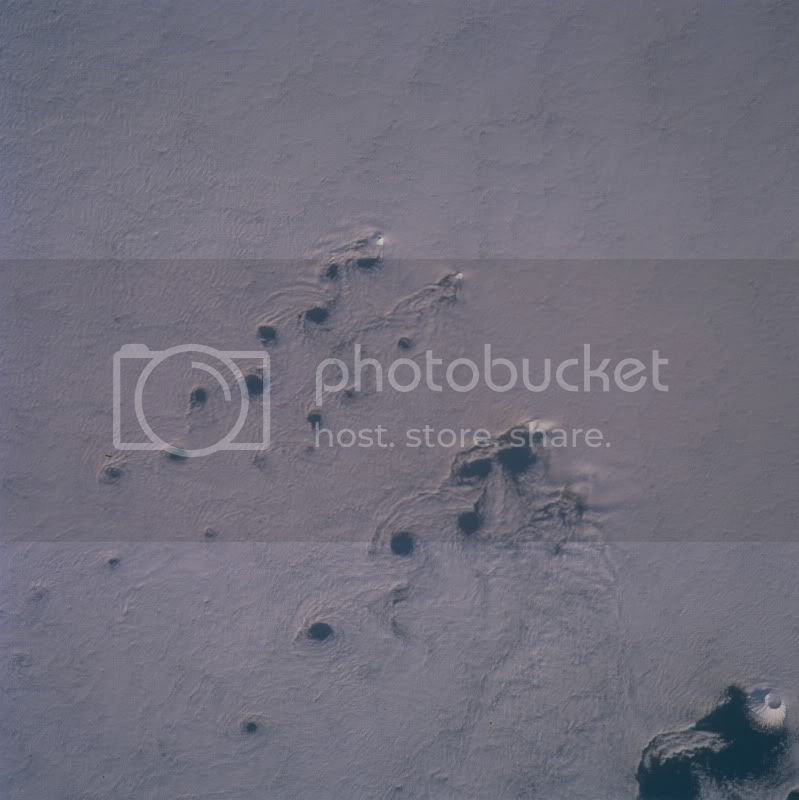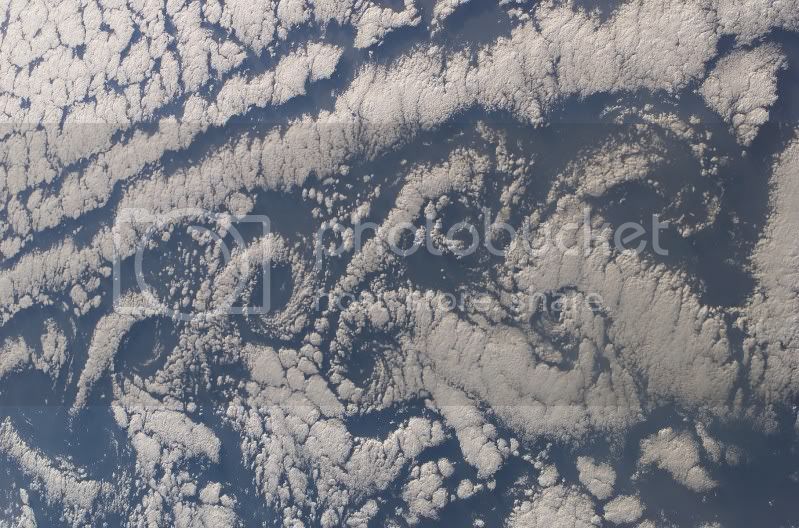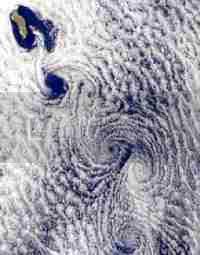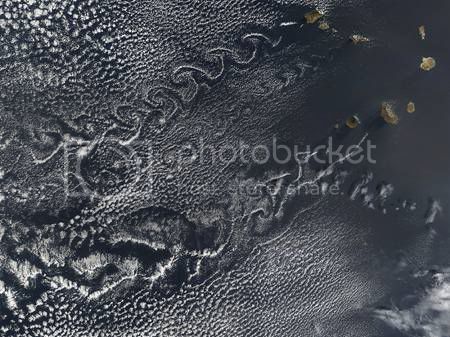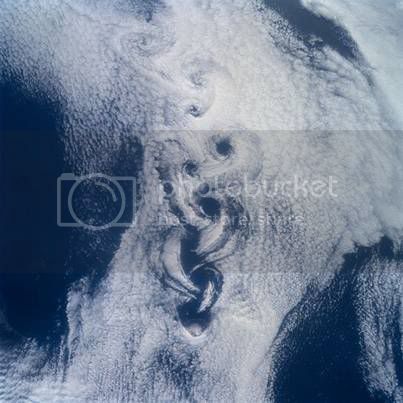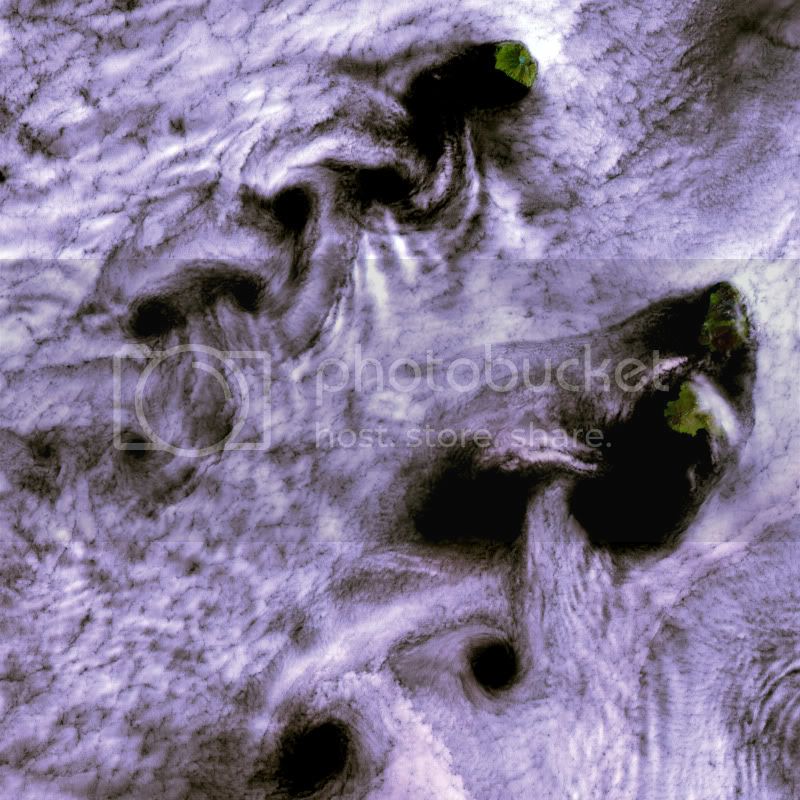
Who knows what this has to do with sailing? This is the basic pattern. Look for it in all the other photos. Can you see the islands?
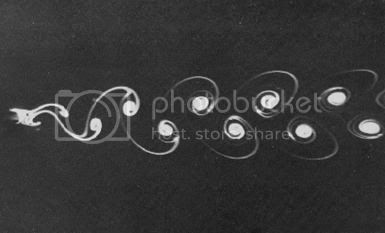
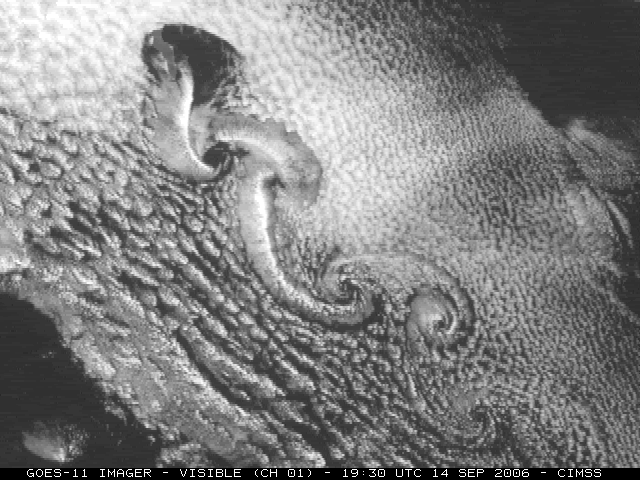
Not what I'm looking for. Not that you are wrong. How can you use this to you advantage from a safety perspective? I'll let other people give their guesses and get back in when I can in the next few weeks. I'll be off sailing.
When a sailing boat is hove to in heavy seas, it creates a wake on it windward side as it drifts downwind. This wake, which is actually a Von Karman Vortex Street, smooths down the approaching breaking waves. If the boat puts out a sea anchor it will also create its own Von Karman Vortex Street providing even more protection for the vessel.
Good answer. I use these pictures to explain how effective the Von Karman Vortex Street as it applies to boats hove-to. Now can you tell me how far upwind a hove-to boat will diminish the wave train to windward?
Larry Pardy has reported that the waves start to lose their power in the slick created by the Von Karman Vortex Street as much as a 1/4 to 1/2 a mile to windward while drifting downwind at 5/8 to 3/4 knot in 70 knot winds.
It turns out that Charles Williamson, our esteemed District 9 Secretary, has published a paper on Karman vortices: "Phase dynamics of Karman vortices in cylinder wakes" So, that's another thing they have to do with sailing.
"Karman vortex shedding is a self-excited limit-cycle oscillation of the entire near wake reached via a supercritical Hopf bifurcation of the steady wake at the critical Reynolds number of Rc ~48." Well yeah. Isn't that basically what I said?